
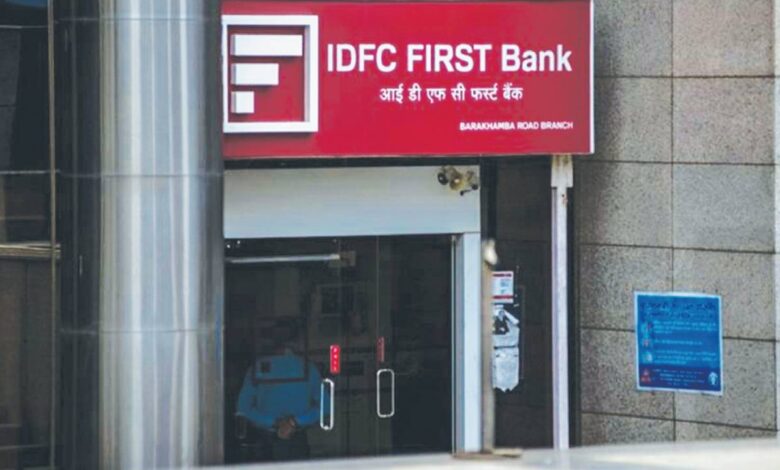
Rs 590-crore fraud hit absorbed? Has IDFC First Bank stock priced in the worst-case impact
Read Time:3 Minute, 30 Second
After a sharp sell-off, analysts believe IDFC First Bank’s valuation reset reflects the worst-case earnings impact of the fraud disclosure

- IDFC First Bank shares steady after Rs 590-crore fraud disclosure
- Analysts predict weak short-term sentiment, minimal long-term impact
- Valuation reset seen as pricing in worst-case earnings impact
IDFC First Bank shares were steady on February 24, a day after the stock plunged 16 percent and erased nearly Rs 12,000 crore in market value following the disclosure of a Rs 590-crore fraud. Analysts now believe that the sharp sell-off has already priced in the worst-case impact on earnings and regulatory risks. While sentiment may remain fragile in the near term as investors await more clarity, they do not see this episode derailing the bank’s medium-to-long-term growth story.
Valuation reset reflect earnings hit
After the sell-off, IDFC First Bank’s valuation dropped sharply, with the stock now trading at 1.34 times its price-to-book (PB) ratio: a 19 percent de-rating from its 5-year average of 1.6 times.
Chokkalingam G, founder of Equinomics Research, said this reset broadly matches the expected financial impact, as the bank is likely to make a 100 percent provision for the amount this quarter. This could result in either a marginal loss or a small profit in Q4, compared with a net profit of Rs 503 crore in Q3FY26.
“The bank’s net worth stood at Rs 41,000 crore at the end of December, and the fraud impact is less than 2 percent of this. In that sense, the stock has been punished a bit more than required. High-risk investors can consider buying the stock with a medium-to-long-term view,” he said.
Street’s consensus target price for IDFC First Bank now stands at Rs 87, slightly lower than the earlier Rs 90, according to Bloomberg data.
No structural governance concern, say analysts
Last year, IndusInd Bank shares fell sharply after accounting irregularities surfaced, leading to its removal from the Nifty 50 index. However, analysts believe the current case at IDFC First Bank is different and does not point to deeper structural or governance issues.
Both the Haryana chief minister and the Reserve Bank of India have assured that the money is safe and will be recovered. The RBI governor also clarified that there is no systemic risk and that the fraud was confined to a limited set of accounts.
Analysts at Emkay Global said the episode could still trigger incremental deposit inflows from the Haryana government, which accounts for about 0.5 percent of the bank’s overall deposits. “While the lapse may delay the bank’s near-term re-rating, it is unlikely to derail its long-term growth and return on assets recovery,” they said.
Emkay maintained an ‘Add’ rating but cut its target price to Rs 80 from Rs 95, citing risks of partial withdrawals from other government accounts and possible second-order impact on business momentum and margins.
Similarly, Motilal Oswal shared a “neutral” rating with a target price of Rs 80, implying about 15-16 percent upside from the current levels, saying that the actual impact would depend on the quantum and timing of recoveries.
“In a worst-case scenario, assuming negligible recovery, provisioning could reduce Q4FY26 profit before tax by 56 percent. However, despite a high credit-deposit ratio of around 93 percent, the bank remains well placed to scale up deposits through competitive rates and network expansion. We expect deposit CAGR of about 22 percent over FY26–28, which should comfortably support loan growth,” Motilal Oswal said.
Meanwhile, Nomura reiterated a “buy” rating on IDFC First Bank, whereas Investec cut its target price to Rs 92 from Rs 105 but stayed positive on the bank’s growth outlook, citing strong core operating profit growth projections.Disclaimer: The views and investment tips expressed by investment experts on Moneycontrol.com are their own and not those of the website or its management. Moneycontrol.com advises users to check with certified experts before taking any investment decisions.


Happy
0 %

Sad
0 %

Excited
0 %

Sleepy
0 %

Angry
0 %

Surprise
0 %
 0
0
 0
0



Average Rating