

Hormuz shock: US-Iran war puts nearly a fifth of India’s imports at risk
Read Time:3 Minute, 16 Second
From crude and bullion to fertilisers and chemicals, 19.7% of India’s import basket is exposed to Strait of Hormuz disruptions

- 20% of India’s imports pass through the Strait of Hormuz
- 46% of India’s oil imports come from Hormuz-linked crude
- Disruptions may hit food, bullion, and chemical imports sharply
The war in West Asia risks spilling over from an oil shock into a broader import disruption for India, with the Strait of Hormuz corridor accounting for 19.7 percent of India’s total imports (including oil). The exposure spans energy, bullion, food products and industrial chemicals, creating a multi-layered vulnerability if maritime disruptions intensify.
Crude oil remains the single largest pressure point. Hormuz-linked crude trade stood at about $65.2 billion in 2024, implying that nearly 46 percent of India’s total crude imports are tied to this corridor. Any sustained disruption could push up India’s import bill and amplify volatility in downstream fuel and transport costs.
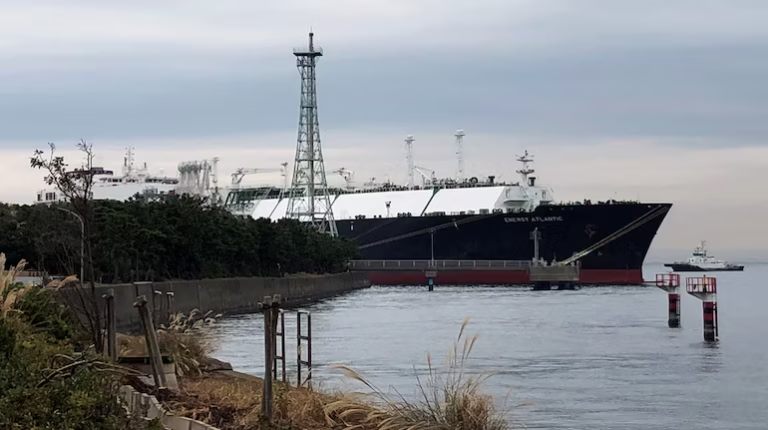
On March 2, Iran’s Revolutionary Guard reportedly threatened to take action against vessels crossing the Strait of Hormuz, heightening concerns about the continuity of shipping through the narrow waterway between Iran and Oman.
Beyond crude, the sharper vulnerabilities lie in specific non-oil items where dependence is far more concentrated.
Crude oil remains the single largest pressure point. Hormuz-linked crude trade stood at about $65.2 billion in 2024, implying that nearly 46 percent of India’s total crude imports are tied to this corridor. Any sustained disruption could push up India’s import bill and amplify volatility in downstream fuel and transport costs.
On March 2, Iran’s Revolutionary Guard reportedly threatened to take action against vessels crossing the Strait of Hormuz, heightening concerns about the continuity of shipping through the narrow waterway between Iran and Oman.
Beyond crude, the sharper vulnerabilities lie in specific non-oil items where dependence is far more concentrated.
Food imports illustrate the concentration risk. India imported about $286 million worth of dates in 2024, of which $265 million, or 92.7 percent, originated from Hormuz-linked economies, led by the UAE ($124.4 million), Iraq ($83.5 million) and Iran ($45.3 million).
Precious metals exposure is even more striking. Imports of unwrought silver show 91.8 percent dependence on the corridor, almost entirely sourced from the UAE (about $1.94 billion). For non-monetary gold, the absolute import base is much larger — roughly $57.3 billion globally, with $16.5 billion (28.8 percent) linked to Hormuz economies, again dominated by the UAE ($16 billion). Any logistical bottlenecks could therefore be transmitted directly into jewellery manufacturing, trading volumes, and domestic bullion markets.
Industrial chemicals add another layer of risk. Ethylene glycol, a key input used in automotive coolants, HVAC systems and polyester (PET) manufacturing, is effectively 100 percent Hormuz-linked in India’s import basket. Methanol carries 87.7 percent exposure, while several polymer and petrochemical intermediates fall in the 50–72 percent exposure range. Disruptions in maritime routes could therefore ripple through plastics, packaging, textiles and manufacturing supply chains, even if oil shipments continue at reduced levels.
Fertiliser supply chains also reveal strategic implications. Saudi Arabia has emerged as India’s top supplier of diammonium phosphate (DAP), with its share rising from 28.3 percent in FY24 to 41.6 percent in FY25, while China’s share declined from 34 percent to 18 percent. In July 2025, India signed a long-term agreement with Saudi Arabia to meet roughly one-third of domestic DAP demand, strengthening supply security but deepening exposure to Gulf shipping routes.
The Strait of Hormuz is not merely an energy artery for India but also a critical channel for food imports, bullion inflows and industrial feedstocks. If the conflict escalates into sustained maritime disruption, the impact could extend well beyond crude oil, affecting inflation, manufacturing costs and external trade balances across multiple sectors.


Happy
0 %

Sad
0 %

Excited
0 %

Sleepy
0 %

Angry
0 %

Surprise
0 %
 0
0
 0
0






Average Rating