
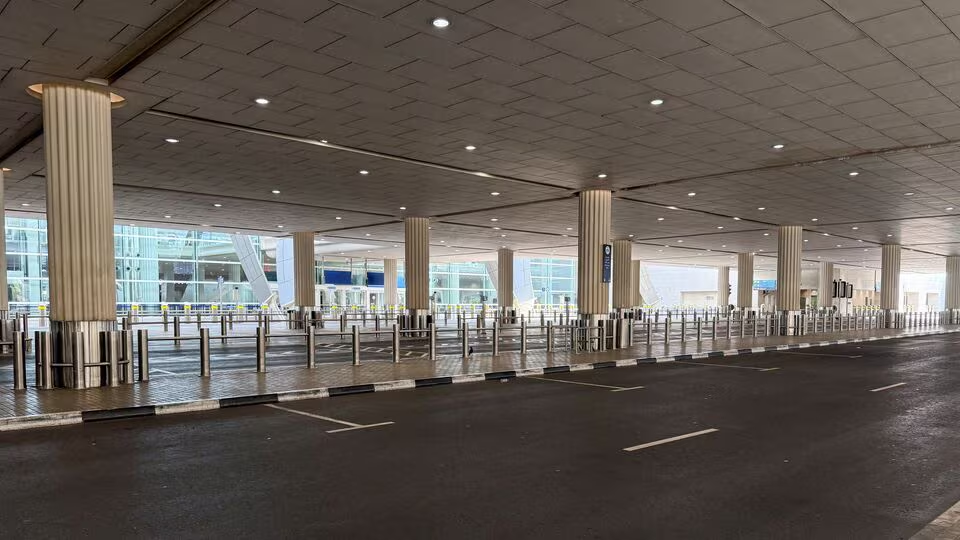
Hospitals brace for ‘soft’ quarter as US-Iran war disrupt international travel
Read Time:2 Minute, 30 Second
West Asia is not just a source market, it is also India’s primary aviation corridor that connects Africa, Central Asia and Europe to India

- Middle East conflict disrupts India’s $13B medical tourism sector
- Flight issues raise airfares 15-25% and delay patient travel
- Hospitals foresee 8-10% revenue drop due to fewer international patients
Escalating war in West Asia is creating sharp operational headwinds for India’s medical tourism sector, posing a risk to a decade of 20 percent compound annual growth.
The industry, projected to grow to $13 billion by year-end, has been hit by flight cancellations and rerouting. These disruptions have pushed airfares by 15 percent to 25 percent and significantly added to the travel time, which can be ill-afforded by critically ill patients.
West Asia is not just a source market, it is also India’s primary aviation corridor that connects Africa, Central Asia and Europe to India.
In 2025, more than 4.5 lakh foreign tourists visited India for medical purposes, with West Asia and Africa accounting for sizeable numbers.
Patients from Oman, Iraq and Yemen account for a large share of foreigners seeking medical care in cities such as Chennai, Delhi and Mumbai for ailments ranging from heart diseases to cancer.
“We are keeping a close watch, we are looking at other regions of the world not affected by the ongoing war,” said Dr Devlina Chakravarty, managing director of Gurugram-based Artemis Hospitals.
Chakravarty said the ongoing disruption could have an 8-10 percent impact on international patient revenue.
Artemis Hospitals generates about 25-30 percent of its revenue from international patients.
Major hospital chains are bracing for a “soft” quarter as West Asian patients contribute between 15 percent and 22 percent to their international revenue.
For Fortis Healthcare, international patients account for 7.7–8.1 percent of the hospital’s business revenue. Around 5 percent of Apollo Hospitals’ revenue comes from international patients and Max Healthcare gets about 9 percent.
Max Healthcare declined comment, while Apollo Hospitals and Fortis Healthcare had not responded to Moneycontrol’s queries at the time of publishing this story.
Industry analysts say that life-saving surgeries like cardiac bypasses often proceed out of necessity, but elective procedures—orthopaedics, dental, and cosmetic surgeries—are being put off.
Wealthier patients who traditionally used Dubai as a “medical hub” for specialised care are finding that corridor blocked but the uncertainty of travelling further to India is pushing them toward Southeast Asian competitors or tele-consultation.
Chakravarty said the dip in international patients would be “transient” and international patients would return twice over once the conflict ends, as was the case after the Covid pandemic and the end of the Afghanistan war.
On February 28, the US and Israel launched pre-emptive strikes on Iran, killing its supreme leader, Ali Khamenini. Iran hit back with strikes on US assets and allies in the Gulf, widening the conflict.


Happy
0 %

Sad
0 %

Excited
0 %

Sleepy
0 %

Angry
0 %

Surprise
0 %
 0
0
 0
0


Average Rating