
OPINION | Why India’s textile PLI must shift focus from capacity expansion to market creation
Read Time:5 Minute, 51 Second
The success of the Indian textile industry will now be measured by the quality of its international relationships. Policy can institutionalise demand creation
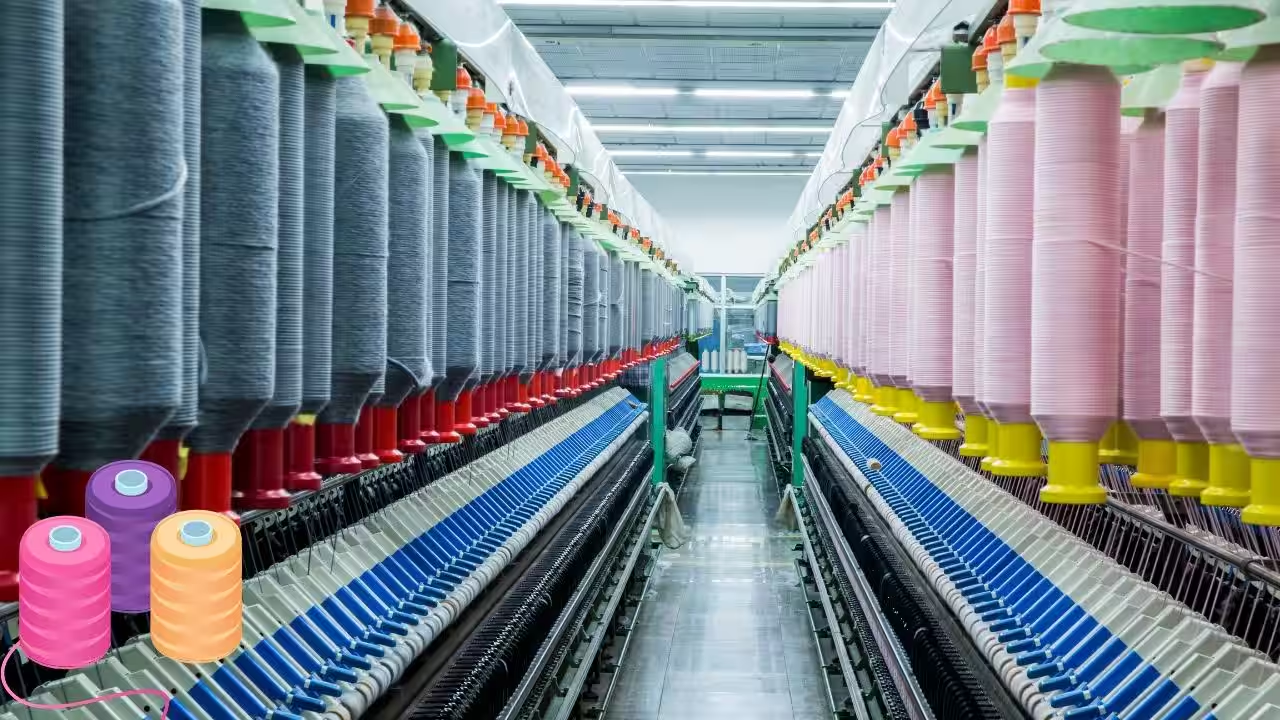
India’s Production Linked Incentive (PLI) scheme has succeeded in doing what it set out to do: catalyse investment, build scale, and modernise India’s textile manufacturing base. Capital has flowed into man-made fibres, technical textiles, and integrated value chains.
The sector today is more organised, technologically enabled, and capacity-ready than it was just a few years ago. Technology upgrades are modernising both greenfield and brownfield expansion. In effect, the industry is steadily moving from a fragmented ecosystem towards an integrated value chain that provides visibility and quality-control.
Capacity addition is important, but not enough
But capacity-building alone cannot fuel sustainable growth. The global fashion and home textile market has faced headwinds such as high inflation, retail slowdown, and geopolitical instability over the last two years, making buyers more cautious in their sourcing.
Now that India has built capacity with PLIs, the next goal must be to encourage demand. If supply continues to outpace demand, it’ll lead to stress in the sector. Under-utilised capacity erodes operating leverage. Margins suffer as suppliers undercut each other with aggressive pricing. Working capital cycles become longer along the value chain, as orders slow, and upstream manufacturers are compelled to curtail procurement.
Capacity without contracts is a structural risk in an industry already exposed to raw material price volatility and other global trade dynamics.
Examples of Vietnam and Bangladesh
To restore balance, the future of policy innovation must lie in shoring up demand. Competing countries such as Vietnam and Bangladesh have built ecosystems. With the help of advantageous FTAs and a stable policy environment, Vietnam is strongly integrated into the global supply chain. Bangladesh scaled its output by partnering with global brands, creating a cohesive sourcing ecosystem with a common supplier base and stable policy environment, graduating from mere cost-competitiveness.
Need to pivot to “Buy from India”
India can outdo the competition with its strong raw material base, entrepreneurial culture, and skilled workforce. Together with our capabilities in MMFs and technical textiles, we are poised to cater to the premium segments of performance wear, industrial applications, and sustainable textiles that are growing steadily. PLIs so far have boosted segment growth rate, but textiles’ share in exports still hovers at a meagre 7-8%.
A strategic pivot from “Make in India” to PLIs encouraging “Buy from India” could accelerate our global competitiveness. Global customers scouting for sourcing destinations that offer long-term stability and policy consistency must find us reliable and transparent. We will grow resilient if we can thus plug into the value-seeking global sourcing pipelines.
Criticality of the EU trade deal
PLI-supported international roadshows in strategic markets such as the US and Europe, coupled with buyer-seller meets, would create demand that is predictable and sustainable. Government support for long-term sourcing agreements, perhaps through institutional arrangements or export promotion councils, would further reduce risks for producers.
The recently concluded India–EU Free Trade Agreement is the kind of decisive demand trigger that the Indian textile industry needs today, and the new market-access makes such engagement even more strategic.
The landmark policy intervention opens one of the world’s largest premium textile and apparel markets by removing tariffs of 4-12%, earlier levied on textiles and garments. The rationalisation will improve India’s competitiveness vis-à-vis Bangladesh and Vietnam in the European Union.
With EU apparel imports reaching $92.56 billion in 2024, India’s $4.52 billion exports account for just 4.9% of the market, a modest share compared to China’s roughly 28%, underscoring both Europe’s scale and the headroom for India to expand here.
It’s no longer about cost arbitrage
But Indian manufacturers must be prepared with scale, compliance, and speed. The evolving global buyer doesn’t get swayed by the cheapest product anymore. They are moving on from pure cost arbitrage to textile partners who can produce value with trust and reliability.
New world brands are no longer buying raw materials but sourcing in a way that fosters a robust, transparent and reliable supply chain, withstanding the test of time and the speed-to-market. The customers are looking for ecosystems they can trust and not just a manufacturing partner. In their search, they are assessing potential manufacturers not just for digital traceability and reliability of the supply chain but also compliance with sustainability and ESG standards.
Building ‘Brand India’ for the textile industry will make a big difference on the global stage. We need to shape our responsible-sourcing identity by showing our compliance with sustainability standards in water conservation and low-carbon manufacturing, labour standards, and with transparent and traceable supply chains. Transparency can become our key differentiator.
Moving up the value chain and away from low-margin commoditisation will build resilience. The world is moving towards MMF blends, recycled fibres, smart textiles, and high-performance technical fabrics. Encouraging innovation with budgets for R&D in advanced finishing technologies and collaborating with research institutions would help future-proof the industry. This could be incentivised with the next phase of PLI schemes.
Pillars of demand-linked PLI
For textile MSMEs that dominate the sector with 80% of its total capacity, demand visibility is critical. Smaller businesses perform well with full order books and predictable cash flows. Policies must support them with export facilitation, digital access to global sourcing platforms, and cluster branding. If they receive demand assurance, they will be encouraged to invest in automation, skill development, compliance, and capacity building.
The 2026 Union Budget too showed policy awareness that manufacturing scale must now be matched by competitiveness and global integration. Its five-part integrated programme, spanning the National Fibre Scheme, cluster modernisation, sustainability under the Tex-Eco Initiative, and advanced skilling through Samarth 2.0, along with Mega Textile Parks, extended export timelines and a Rs 10,000-crore SME Growth Fund, reflects the intent to strengthen market readiness for global demand. However, the recent move to halve RoDTEP export incentives, which can only raise textile export cost, is counterproductive.
A demand-linked PLI 2.0 to strengthen Brand India in textiles must rest on four pillars:
- Market access (FTAs and export diversification)
- Value addition (technical textiles, MMFs, innovation)
- Buyer integration (long-term sourcing contracts)
- Sustainability leadership (traceability and green manufacturing)
The success of the Indian textile industry will now be measured by the quality of its international relationships. Policy can institutionalise demand creation and long-term buyer integration, while the industry focuses on reliable deliveries and a compelling value proposition beyond cost competitiveness. The next chapter of PLIs must demonstrate that India can maintain its investment momentum. Let’s remember that capacity built without global integration risks erosion for all stakeholders in the industry.Raghunath Mannil Balakrishnan is CEO, Mafatlal Industries Limited. Views are personal and do not represent the stand of this publication


Happy
0 %

Sad
0 %

Excited
0 %

Sleepy
0 %

Angry
0 %

Surprise
0 %
 0
0
 0
0






Average Rating