
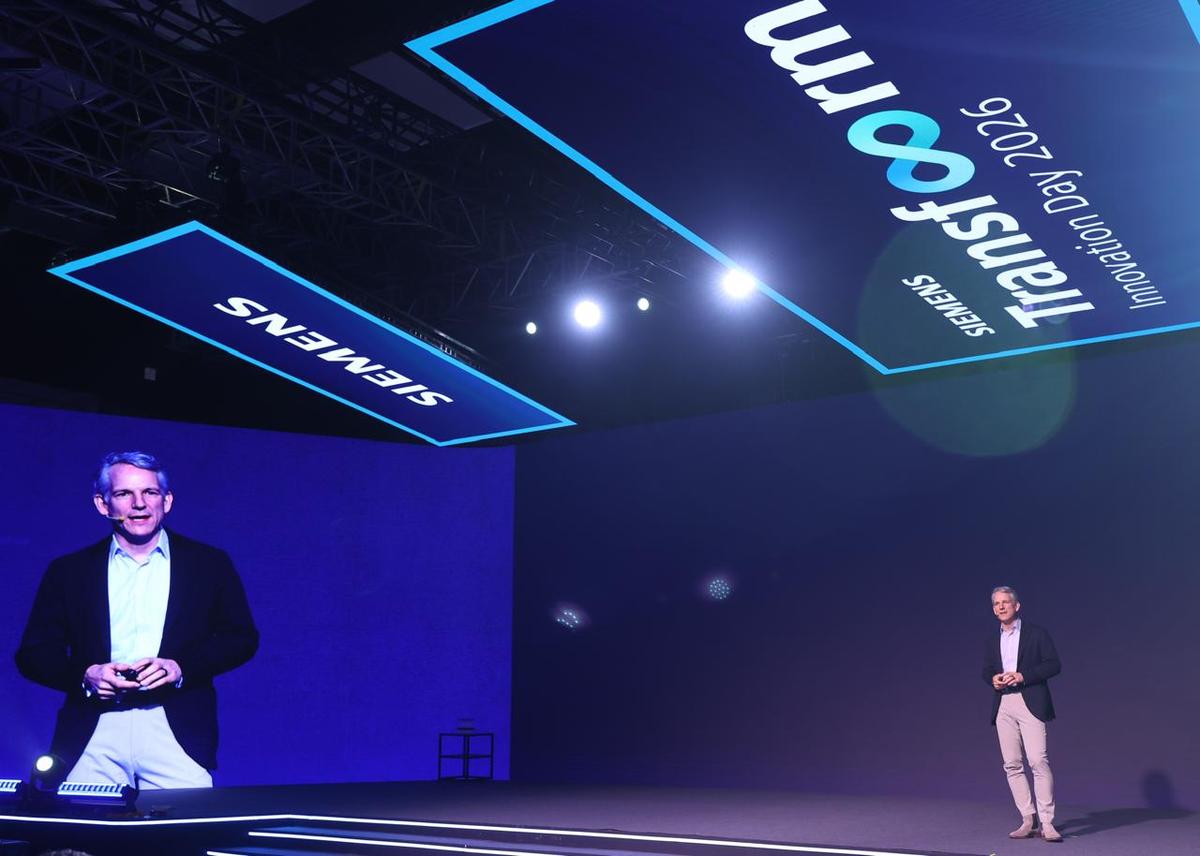
Siemens sees AI-driven shift in workforce mix, India to have smaller tech teams work on value creation for new products: CTO Peter Koerte
Read Time:3 Minute, 23 Second
The company has about 10,000 software and AI experts across its global innovation centres in Bengaluru and Pune. India is Siemens’ fourth largest market, contributing significantly to its revenue growth.
German engineering services giant Siemens is seeing a shift in its workforce mix and competencies, focusing on talent with skillsets in artificial intelligence (AI) and data, said Dr. Peter Koerte, member of the managing board, Chief Technology Officer and Chief Strategy Officer at Siemens AG.
Koerte said that this will be an overall opportunity for Siemens’ technology teams in India too, as they will now be able to participate in value creation for newer products, and work beyond traditional software development.
Siemens currently has 38,000 employees across India, with the listed entity Siemens Limited having around 6,200 people, and 25 factories.
The company has about 10,000 software and AI experts across its global innovation centres in Bengaluru and Pune.
“It’s a shift in competencies and mixes for sure. We need more data scientists because data is the key thing in there. These are job families that we’re looking very much on. In AI, there are also people trained in just traditional machine learning algorithms and we’re looking for them,” Koerte told Moneycontrol in an interview on the sidelines of Siemens India Innovation Day in Mumbai.
He added, “UX designers are becoming important. Because the question is not only what’s AI but where do you use the AI and how do you consume it.”
According to Koerte, while consumers could access AI through smartphones or web applications, interactions become complex when it comes to industrial AI.
Siemens is working on bridging these gaps, to find alternatives where people could interact with AI on shop floors where they are not able to use their phones or computers.
“These are the things that we’re exploring and we need people coming from different industries in order to inspire (us),” Koerte said.
Building smaller teams
Koerte noted that India will find its AI opportunity in building the applications layer, as one starts rethinking traditional software development where the country has been a leader.
Within Siemens too, he expects there will be a change in how software development teams are getting structured.
“Copilots and AI tools are terrific tools to use for software coding. You need to rethink of how software development teams are structured. Architecturally speaking smaller teams with higher caliber in terms of knowledge that’s a trend that we’re seeing,” he said.
Koerte added, “For India, it means two things. One, the teams will become smaller but two, they will become more a part of the value creation of a new product because as I said you can’t just throw the requirements off the fence. It’s an opportunity.”
‘India benefits the most from Industrial AI’
During his keynote at the event, Koerte said physical AI is going to be massive opportunity over the next few years, and India is set to benefit the most as almost 87 percent of domestic enterprises use AI solutions — a stark contrast from the AI adoption gap seen in rest of the world.
“There are very few countries that is growing at a 7% GDP like India. The future is absolutely bright for India to come,” he said.
In the global AI race, you have the US and China, and everybody is asking about India’s role in this given it’s strong position in software development services for the world. India is going to be a major force in AI. India is going to benefit the most from applying AI in the various industries we see emerging,” he added.
Koerte highlighted that he expects a “lot of applications coming from India for the world” that will make Siemens more competitive.
In terms of Siemens’ global business, India is its fourth largest market, contributing significantly to its revenue growth. The German multinational projected enormous demand driven by the policy tailwinds around data centre tax holiday extension, IndiaAI Mission, India Semiconductor Mission 2.0 among others.


Happy
0 %

Sad
0 %

Excited
0 %

Sleepy
0 %

Angry
0 %

Surprise
0 %
 0
0
 0
0




Average Rating